Could the US Survive a War With China?
What would later be referred to as World War I was supposed to be a short, sharp war, in which the Germans would in a matter of a few weeks occupy Paris. The First Battle of the Marne in early September 1914 saw the end of the German advance at a point north and east of Paris, at a cost of over half a million total casualties. “The Battle of the Marne was one of the decisive battles of the world not because it determined that Germany would ultimately lose or the Allies ultimately win the war but because it determined that the war would go on,” writes Barbara Tuchman in The Guns of August. “The nations were caught in a trap, a trap made during the first thirty days out of battles that failed to be decisive, a trap from which there was, and has been, no exit.” A whole nineteenth-century world was lost, with all of its brilliance and all of its collective naïveté, and the terrifying future began. And no one, to paraphrase the Belgian socialist poet of the era, Émile Verhaeren, would ever again be like he “used to be.”
To recreate just how brilliant and utterly absorbing was that nineteenth-century world which was lost in just a few weeks of fighting in the late summer of 1914, Tuchman followed The Guns of August with The Proud Tower: A Portrait of the World Before the War, 1890–1914, which was published four years later, in 1966. By bringing fully, magically almost, to life the quarter-century before war, Tuchman reveals, in a way more so than in The Guns of August, even (however indirect the writing this time), just what in historical terms was the extent of the devastation.
The differences with our own age are great, but the similarities are shocking.
There is the elite aristocracy, with all of its confidence and all of its advanced degrees and all of its privileges, that eventually gets the whole of Europe into the conflagration. There is the hideous poverty and working-class conditions—in the mines, the textile factories, the steel mills—with all of their dangerous, low-end jobs and lack of hope, that produce both the era’s anarchists and its socialists. There is the anti-Semitism that erupts as the old order begins to collapse with all of its building social and political tensions. The public spectacle of the Dreyfus affair in France, in which a Jewish army officer is wrongly accused of treason, revealed “what energies and ferocity were at hand to greet” the new century. Mixed with this was the “unchained energy” of the new technological age, with its nonstop production of amazing new gadgets and armaments.
No conflict in the world today has the capacity, if miscalculated, of bringing ruin upon us all, like the one between the United States and China.
England became increasingly conscious of the threat of Germany. Reginald Brett, Lord Esher, wrote to a friend in 1908, “that in Europe we have a competitor the most formidable in numbers, intellect and education with which we have ever been confronted.” Like China today!
“The proud tower,” Tuchman writes, “built up through the great age of European civilization was an edifice of grandeur and passion, of riches and beauty….Its inhabitants lived, as compared to a later time, with more self-reliance, more confidence, more hope; greater magnificence, extravagance and elegance; more careless ease, more gaiety, more pleasure in each other’s company and conversation.” She goes on, juxtaposing it all with the working-class poverty and injustice that was also everywhere. Imperfect it may manifestly have been, of course, yet its utter loss constituted one of the great tragedies of history, as no one, to repeat, could ever be what he used to be.
The image which Tuchman chose for her book title is from a poem by Edgar Allan Poe, “The City in the Sea” (1845):
While from a proud tower in the town
Death looks gigantically down.
We need to be scared, very scared, at what we may be bringing about. No conflict in the world today has the capacity, if miscalculated, of bringing ruin upon us all, like the one between the United States and China.
*
“We have now crossed over into a period in which things happening in Asia will largely determine the course of events everywhere in the world,” wrote Owen Lattimore in 1945. That has finally come true. Asia, note policy experts Robert D. Blackwill and Richard Fontaine, is now home to 60 percent of the world’s population, three of its five largest economies, close to half of global GDP, two-thirds of the world’s economic growth, and over half of the world’s biggest armies, defense budgets, and nuclear weapons states. China especially, which dominates Asia, explains the defense strategist Elbridge A. Colby, is “an object so large” that it “must have the greatest consequence for any system that must accommodate it.” Indeed, a “decent peace” as Colby frames it, that allows for American prosperity and security, “does not spontaneously generate.” This may seem obvious but it is not.
History demonstrates that war is a perennial human condition, and peace merely the interregnums between wars. Peace must be ferociously worked at, and requires great risks of its own. America can shrug off the wars in Iraq and Afghanistan, which in the larger scheme of things, despite all the loss of life and devastation, were merely far-flung imperial adventures gone awry. Life went on afterward, at least in the West. Life will not go on so easily in the West were there to be a war with China. As Stapleton Roy told me, the Asian equivalent of the Cuban Missile Crisis may still lie ahead. And as Evan Medeiros said, the Asian equivalent of the Cuban Missile Crisis may be far more complicated and given to miscalculations than the original one.
Indeed, the issues and perceptions that divide the United States and China must continue far into the future. “For we stand at each other’s antipodes,” writes the Belgian-Australian essayist Simon Leys. Just consider: the Chinese view the South China Sea and its environs as their home waters, the blue-water extension of their continental landmass, the way the United States viewed the Caribbean as soon as we had conquered the temperate zone of our own continent in the late nineteenth century. The United States, contrarily, sees itself as an Asian power, too: going back to Commodore Matthew Perry’s opening of Japan to trade in 1853, followed by the Philippine theater of the Spanish-American War at the turn of the twentieth century, World War II in the Pacific, then Korea and Vietnam, however frustrating and disappointingly those latter wars turned out. Now in the cyber age, war is just a click away rather than hundreds and thousands of miles away: something further destabilizing the bilateral relationship. Whereas in the recent past, Communist China had a line of rulers beginning with Deng Xiaoping that governed as benign authoritarians in a risk-averse style, with which the United States was comfortable dealing, China at least at the moment has a hardcore Leninist, Xi Jinping, in total control, so that a zero-sum ideological divide poisons the bilateral relationship.
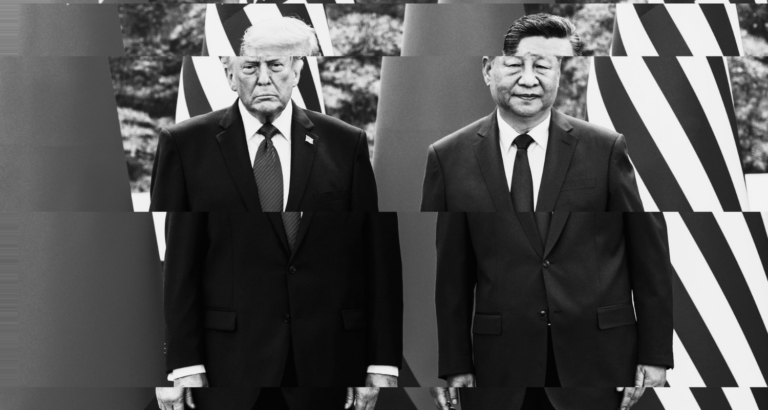
Finally there is trade. As part of defining China as the principal enemy to the American worker on the world stage, President Donald Trump not only ignited a further military buildup against China, but commenced a trade war against it. Whereas the Obama administration had believed in an Asian free-trading regime even though it was unable to secure it, the first Trump administration aggressively challenged Beijing, complete with both hostile restrictions and tariffs. Significantly, the Biden administration, which replaced Trump in 2021, continued and enhanced those trading restrictions, and further developed our Asian military alliances with a latticework of agreements, including a deal to sell nuclear-powered submarines to Australia and patching up a historic dispute between Japan and South Korea in order, however unstated it was, to confront China.
We should always try to stretch our imagination, since the great events to come in China may be unimaginable until they actually happen.
Thus, rather than an aberration, Trump in both his first and second terms, despite summit meetings, with all of their comforting and deceptive rhetoric, has begun a new era of enhanced American unpredictability toward China, something which would have seemed improbable in the decades influenced by Nixon’s and Kissinger’s diplomacy. Nor have the prospects of a green revolution in technology, by providing the United States and China with a new platform for cooperation, alleviated any of this, as many have thought. A nationalistic industrial policy directed against China will likely continue into an age of cleaner, post-industrial technology.
But we can’t just give up or go soft in our dealings with China. That would be too convenient. That’s what makes avoiding a military conflict with China so difficult. After all, deterrence is vital. “There is a persistent myth,” writes Yale historian Odd Arne Westad, “that alliance systems led to war in 1914 and that a web of mutual defense treaties ensnared governments in a conflict that became impossible to contain. In fact, what made war almost a certainty was Germany’s ill-considered hope that Britain might not, after all, come to the assistance of its friends and allies.” Now think of the United States and Taiwan in that regard.
Unfortunately, miscalculations are baked into the complex scheme of things. We have miscalculated with China before. In fact, this book has been a story about how we enduringly miscalculated both the Chinese Communists’ rise to power and their willingness early on to consider a relationship of some kind with the United States. The result of that failure contributed to the Korean and Vietnam Wars. Truly, getting it right with China was never easy and is made harder by a factor that must continue into the future: the place that human passion and imperfectibility play in the policy process. That is the burden we labor under. It is also why Nixon’s and Kissinger’s opening to China, which enabled the policy of détente with the Soviet Union, was and will remain such a historical achievement: since it helped stabilize superpower relations at an unpropitious moment, thus keeping the peace during some of the most difficult days of the Cold War. It was a matter of waiting the Soviet Union out, until changes could occur within it; just as we may have to wait China out before changes can occur within it, changes of their own accord that we ultimately cannot precipitate or even influence much. We cannot afford to blindly build a proud tower.
That is, we cannot afford to blindly drift into a twenty-first-century equivalent of World War I. For the moment, Washington and particularly the Pentagon are obsessed with war planning, replete with scenarios for missiles, submarines, surface warships, fighter jets, ground forces, and cyber weapons, all in the service of a full-scale military conflict with China over Taiwan and the South China Sea. China for years now has been “the pacing threat” for the Pentagon. The Pentagon deals with the Middle East because it has to; it deals with Ukraine because it has to. But the obsession of the building is with China: bringing us closer to a war that, to repeat from my conversation with Stapleton Roy, could devastate financial markets including retirement accounts, and thus change our world and our lives demonstrably for the worse; again like World War I.
Indeed, fear and loathing of Communist China is the one thing in foreign policy that both political parties and our military can now agree on. The fact that we got along with the Soviet Union for decades when it was Communist is practically forgotten. In fact, dealing with the likes of Leonid Brezhnev, Yuri Andropov, and Mikhail Gorbachev was actually a lot easier than dealing with the post-Communist Vladimir Putin. Likewise, we should not automatically assume that what follows Xi Jinping will necessarily be better. Chaos or an unstable and virulently nationalist regime could also be the result, even as China has been dramatically increasing its nuclear arsenal. This is worth pondering since Xi’s Leninist autocracy could mark the last phase of Communism in China. China has for thousands of years witnessed the rise and fall of dynasties, and Communism might turn out to be yet another Chinese dynasty. We should therefore try to coexist with China if and while we can. To repeat, we should not turn our rivalry into a zero-sum ideological conflict between Communist authoritarianism and democracy. There is enough to divide the two countries—trade, Taiwan, and so forth—without resorting to that.
The second Cold War, this time between the United States and China, may signal the last phase of bipolar geopolitical conflict before the arrival of a true multipolar and multiplanetary human civilization: one that will entail such a myriad of political interactions that it will not as easily reduce itself to such a stark struggle between two states. Our goal, therefore, should be to survive this current phase of conflict. That was the operating assumption of many of our China whisperers. And never has it been so difficult, with China matching and even surpassing the Pentagon’s obsession with militarizing the Western Pacific; and with one war game after the other demonstrating that a limited military conflict could instantly escalate into a regional and global war with tens of thousands dead and wounded. That is why understanding the cultural nuances of China is more important now than ever. Alas, our so-called interconnected world that erases cultural differences like those between the United States and China is an illusion.
Furthermore, we should always try to stretch our imagination, since the great events to come in China may be unimaginable until they actually happen. In the summer of 2025, there were actually some rumors that Xi Jinping was being sidelined along with his fellow hard-liners in a quiet coup. It turned out that the rumors were unfounded. But who knows what lies ahead—in both China and the United States? Our China whisperers are not soothsayers, but they stand closer to the truth than the rest of us.
______________________________
From China Whisperers: The Voices That Have Shaped America’s Views of Its Chief Geopolitical Rival by Robert D. Kaplan. Copyright © 2026. Available from Scribner, an imprint of Simon & Schuster.
BlogZone shows headlines and summaries from public news feeds. The full story is published by Literary Hub.
Read the full story at Literary Hub →Enjoyed this?
Get more stories like this — and write your own — in the BlogZone app.