Daniel Miyares on How To Say Goodbye in Cuban
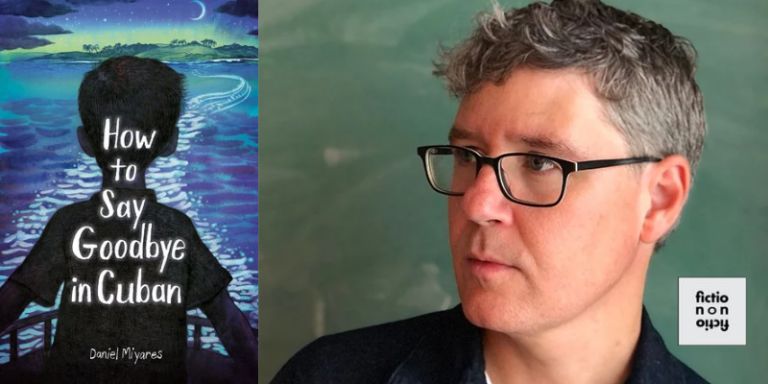
Acclaimed children’s picture book author and illustrator Daniel Miyares joins co-hosts V.V. Ganeshananthan and Christian Barter to discuss his first graphic novel, How to Say Goodbye in Cuban; immigration and Cuban history; and the effects of U.S. sanctions on Cuba, which have existed for decades and continue to intensify under the second Trump administration. Miyares explains how he decided to research and write about his family’s immigration through a fictionalized version of his father’s journey as a young boy. He describes his father’s move from Cuba to the United States during the Cuban Revolution and shares his community’s varied political perspectives. Miyares considers why he chose to illustrate the book by hand using ink and watercolors, and also talks about the challenges of research and narrating someone else’s story. He reflects on what it meant to collaborate with and talk about storytelling with his father, who passed away before the project was completed. Miyares reads from How to Say Goodbye in Cuban.
To hear the full episode, subscribe through iTunes, Google Play, Stitcher, Spotify, or your favorite podcast app (include the forward slashes when searching). You can also listen by streaming from the player below. Check out video versions of our interviews on the Fiction/Non/Fiction Instagram account, the Fiction/Non/Fiction YouTube Channel, and our show website: https://www.fnfpodcast.net/ This podcast is produced by V.V. Ganeshananthan, Whitney Terrell, Emily Farris, Sydney Perkins, and Emma Ware.
Daniel Miyares
How to Say Goodbye in Cuban • That Is My Dream!: A picture book of Langston Hughes’s “Dream Variation” • Float
Others
US escalates economic campaign against Cuba and targets China-based suppliers • Marco Rubio’s compelling family story embellishes facts, documents show – The Washington Post (October 20, 2011) • New York Times Topics: Cuba
EXCERPT FROM A CONVERSATION WITH DANIEL MIYARES
V.V. Ganeshananthan: Can you talk about the art that’s in here? How did you conceive of and draw these images to accompany this? What were you using?
Daniel Miyares: Sure. You mentioned at the beginning of the show that this is my first graphic novel, and it was one that was really important to me because it’s part of my family’s history, my family story. And I couldn’t think of a better way to approach it than drawing it by hand and using ink. Because when I was a kid—I was probably about four years old—my father gave me my first bottle of India ink and a dip pen, and he let me use it in our basement. And I think my mother was probably furious because I got ink everywhere. We used to have a Commodore 64, if you can remember those old computers?
VVG: I do.
DM: And the printing paper for those was all connected, like a big long string of paper, and it had holes down the side. I took that paper and strung it across the entire basement, and I just took that ink and I just drew all over almost every piece of paper we had in the box. And I got ink everywhere! You know, I’m left-handed, and dip pens are a little trickier when you’re drawing left-handed. And it was just all over me, all over the floor, all over the paper. It was glorious, but I’ve always had a fondness for drawing with ink since then, and so I try to incorporate it into my art as much as possible.
But when I started working on this book, I thought I want to draw it. I want to draw it in ink and paint it with inks, and then scan it all in at the end. You know, I didn’t want to use the computer to create the art, and so I did [use ink]. And I felt like it was a great, authentic way to learn the medium, learn the idea of telling stories in a graphic novel because it was my first one. And I felt like drawing things by hand was a great way to learn, almost trial by fire. But really, if you made a mistake, you had to, like, cut out a new character’s head with a piece of paper and glue it down and draw over it, and I just love that process of push and pull, and really being in tune with the surface of what I was creating. And plus, back in the early ’60s, they didn’t have computers either, and so I felt like there was a nice connection of the ink and watercolor with the waterproof black ink. And I just wanted to kind of make all those connections through how I approached it.
VVG: Well, it’s really gorgeous. Reading this book is like listening to vinyl.
DM: I like that. No, I love that!
VVG: It just feels very alive. So I think this particular passage really stuck with me because we see Carlos has moved to this new neighborhood. He’s moved to the city from the country, and he’s trying to make new friends. And his new friends—their parents’ political sympathies lie elsewhere—and they question his allegiance, his father’s allegiance. And his mother is warning him about community surveillance. And of course, in that situation, the bullying is arising from Castro supporters. So we started at the top of the show talking about Marco Rubio because he’s been in the news, one of the people announcing sanctions against Cuba. And I was reading that his family left during the Batista years, and that that’s considered a different wave of migration than the one your family experienced, leaving after Castro and his rebels had gained traction. And I wondered if I was understanding that correctly, and if you could talk a little bit about the different waves of emigration as you understand them, or as you as you came to hear about them from your family.
DM: The more I heard in conversations with my family and researching, the more I realized that it’s really about just understanding the ‘why’ behind what would motivate a person. In this case, my grandfather. What would motivate him to pick his whole family up and put all of their lives in danger to leave the country? And those motivations, I think, changed at different time periods for different families because of their situations. And early on, I think probably some people saw the corruption and the exploitation of Cuba, and felt like ‘there’s got to be a better way, we I don’t see good things happening or good things on the horizon.’
Because Batista was a dictator. I make no bones about it. I mean, he could suspend constitutional rights just as quick as anyone, and I imagine people left early on because they didn’t want to be subjected to that, or have their kids subjected to that—the whims of someone who was in bed with mobsters and American corporations. So I could definitely see that early on. But after the revolution, I think with people and businesses that were nationalized, and people with farms that were taken, there was definitely a financial motivation for wanting to find a better way to live their lives. But I think also, they could see the writing on the wall and things weren’t going to get much better. And the fighting didn’t just stay in the country, and it didn’t stay in the mountains forever, and I think people were afraid for their families.
But my family, in particular, my grandfather, was very pigheaded in some ways. But I think he was very self-motivated. He wasn’t very educated; all he knew how to do was make furniture, and I think it was his dream to make something of that. And so he literally won the lottery. It wasn’t like the Powerball, but people ask me, “Is that true?” And there’s some things I had to fictionalize, but that is not one of them. He won the lottery, and won enough money to build their house and his shop. And they did the woodworking behind the house and the upholstery in the city. And so he felt like he really made something of himself. But then that was all taken away and he just couldn’t stand for that. So I imagine there was that next wave that was the educated, the upper middle class, and people with means and a way to get out.
But at the time when my family left, the borders were closed. The Cuban Coast Guard was monitoring the coast, and they weren’t just like turning people around, they were executing people in the ocean. It was well known that they weren’t very nice to people that were trying to leave. Because there was this fear, I think, at that time that Castro was afraid. He used the poor people in the country to help him fight his war. But the people from the country, they weren’t situated to be able to govern right. They needed the educated folks who could be the lawyers and navigate legal systems and things like that. But all these people were trying to get out of the island. They had this brain drain going on, and they had to preserve that, at least right away. And then after that wave, it became this political football, through John F. Kennedy and Castro. That they were making deals, and at different times, windows would open up, like Pedro Pan—those flights where they flew children out, parents were sending children out.
Transcribed by Otter.ai. Condensed and edited by Emily Farris, Sydney Perkins, and Emma Ware.
BlogZone shows headlines and summaries from public news feeds. The full story is published by Literary Hub.
Read the full story at Literary Hub →Enjoyed this?
Get more stories like this — and write your own — in the BlogZone app.