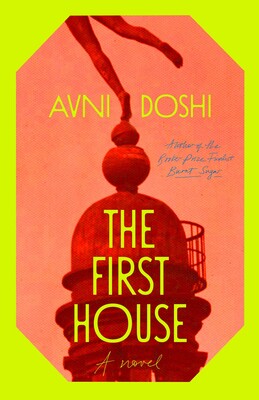
The First House
When my husband comes into the bedroom we have shared for thirteen years and tells me he doesn’t want to be married anymore, I reach for my neck. My head is missing.
My husband has cut it off surreptitiously.
The air in the room thins as he fills it with justifications, all the ways he is unhappy, the reasons why we aren’t right for each other anymore. I tell him to stop, stop talking, can’t he see that I can no longer breathe. He looks startled, as though he doesn’t understand what I mean, as though he isn’t holding it right there, my head in his hands.
*
Before he entered, I was sitting at the small table I use as a desk, pretending to work on my novel. But the annotated outlines and handwritten notes from a decade earlier concealed what I had actually been studying, quietly, for the last year: my own birth chart, set in a circular zodiacal wheel.
He came into the room soundlessly, which was unlike him. My husband was noisy in the way he moved, ate and slept. His feet were heavy, the floors in our house creaking under them, his body cutting through air and whistling wherever it went.
“Are you too tired to talk,” he mumbled, and I jumped, his breath marking the back of my neck. He was standing with his hands in his pockets, bouncing gently as though he had to go to the bathroom.
I hastily covered the chart. “Are the girls asleep?” I asked, motioning to their rooms at the end of the hall, imagining they couldn’t be, not so fast, and aware of the accusation in my tone–it was his night to tuck them in, after all. I noticed that he had closed our bedroom door.
It was April, and the white flowers were blooming on the Bradford Pear in our yard, the semen-stench wafting through the open window beside me. But my familiar feeling of revulsion at that scent evaporated as my husband launched into the story of his misery.
From the beginning, from his first sentence, the conclusion was forgone. Every argument he had carefully accumulated pointed in the same direction. He was fluent in all of the ways that we were incompatible. As he spoke, I felt inside of me a sudden winter. The room tilted, and then the earth, a few degrees farther from the sun.
There were the particulars: my short temper, our fights, and their worsening over the last few years, had made it clear to him that there was no hope for us. Our trajectory was bleak. The way I spoke to him, my resentment, my disdain–he couldn’t tolerate it anymore.
My anger left him flaccid, and at the end of the day, he dreaded coming home.
There was the general: marriage was impossible for him, not just with me, but as a concept. He realized he didn’t believe in it, that it was a sham. Of all the couples we knew, there were none who were actually happy. I couldn’t deny this, he insisted. In fact, I was a historian in the matter, because every night in bed, he listened to me dissecting the lives of the many unhappy couples we knew. Monogamy was unnatural, though we all pretended otherwise. But to ask him to believe in an institution that he had no faith in, well, that was like asking him to believe in someone else’s god.
I was stunned by his arguments. He didn’t believe in any gods. When I recovered my ability to speak, I asked him whether he was sleeping with someone else.
He ignored my question and answered others that I hadn’t asked. No, of course not, of course he didn’t regret marrying me, it wasn’t a mistake, and he wasn’t trying to live the way his single friends did. He continued on this point until it became clear to me that he did in fact harbor some regrets.
Gasping, I told him that I loved him, that we had our daughters, who loved him too–what about them?
He insisted that he adored the children, would always be there for them, and he loved me too, of course, and that families didn’t break, they only changed. This was an evolution for us, nothing more.
“You can’t just wake up one day and make a decision like this,” I said.
“This isn’t a sudden decision,” he replied. “I’ve been thinking about this for a long time.” He stood in front of our bed, and stared down at his side, the side that he had slept on for the entirety of our marriage, his focus unwavering, as though he was scrutinizing a younger version of himself. Then he lay down on that very spot, looking at the ceiling, joining his fingers in the middle of his chest. “I’m doing this for both of us,” he said. “I know you can’t see that right now, but one day you will.”
Was he speaking to me? Or the younger version of himself that he had squashed on the bed? I rose and moved closer, gazing at his face. I thought I would see anguish there but instead all the creases had vanished, years of worry smoothed away. For a moment, I thought he was drunk. But it was relief, I realized, softening his expression.
__________________________________
From The First House by Avni Doshi. Used with permission of the publisher, Summit Books. Copyright © 2026 by Avni Doshi.
BlogZone shows headlines and summaries from public news feeds. The full story is published by Literary Hub.
Read the full story at Literary Hub →Enjoyed this?
Get more stories like this — and write your own — in the BlogZone app.