Watching The Librarians With Librarians During Banned Books Week
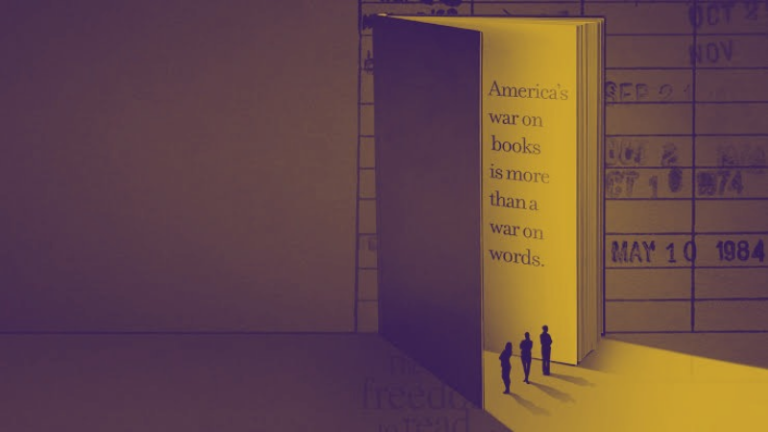
On Tuesday, Oct. 6, in the middle of Banned Books Week, three intrepid high school seniors—Laird Bowser, Alec Thomsen, and Devin Protti—spearheaded a sold-out benefit screening of the 2025 documentary The Librarians in Santa Cruz, California. In collaboration with Bookshop Santa Cruz, the Humanities Institute at UC Santa Cruz, and Santa Cruz Public Libraries, their efforts raised $5,248 for the purchasing of banned and challenged books for Santa Cruz City school libraries.
Depending on where one lives, this Emmy award-winning film by Kim A. Snyder is either cautionary tale or harbinger. The catalyst is former Texas State Representative Matt Krause, working in concert with current Texas Governor Greg Abbott in 2021, who produced a list of 850-odd books deserving of removal that touched off a wave of book bans across America, with the help of the Moms for Liberty; Patriot Mobile; small town and small-minded politicians; and shadowy conservative figures who clearly would seed Project 2025.
Speaking at Colligan Theater, County Superintendent of Schools Dr. Farris Sabbah cited an alarming figure: PEN America found that in the ‘25-’26 school year, “There were 11,982 book bans in public schools, the highest number they’ve recorded since they started keeping track.” He encouraged skepticism of arguments framed around ideology infecting our schools, with books as the carrier. Rather: “Inclusion and representation are not political. Exclusion and erasure are.”
There were 11,982 book bans in public schools, the highest number they’ve recorded since they started keeping track.
The film keeps revisiting the ultimate story of erasure, Fahrenheit 451, Ray Bradbury’s sci-fi parable that uses the imagery of Nazi book-burning still fresh in the post-WWII public’s mind to get at the figurative book-burning of McCarthyism, including in a striking shot fading from a book bonfire in Francois Truffaut’s 1966 adaptation to a real one in Mt. Juliet, Tennessee, in 2022. Bradbury himself was investigated by the FBI for Communist sympathies, with an informant quoted: “the general aim of these science fiction writers is to frighten the people into a state of paralysis.”
Banning books is personal to Protti—Bookshop Santa Cruz is owned by his family and managed by his mother, Casey Coonerty Protti. Even at three years-old, he loved dusting the bookshelves. Given the choice between the beach, mini golf, or drag races for his eighth birthday, all he wanted was to work the register as a bookseller.
His first fundraiser was so the Boys and Girls Club could participate in the bookstore’s summer reading program. That summer and the one following, Bowser, Thomsen, and he shelved books, and were shocked to see their personal favorites destined for the Banned Books section that proudly faces the entrance. Why were former and current offenders banned, they wondered, and who was doing the banning? More importantly, “What does it mean for our community when kids can’t get access to stories that represent them, or simply let them imagine a world beyond their own?”
Enter Barbara Lawrence, the librarian at Gault Elementary for 15 years. Coonerty Protti had worked with her during Covid to buy books for kids left library-less by remote learning. Lawrence had seen The Librarians at an American Library Association conference and clued the three into its existence. Protti told the audience he and his friends wanted to show a community untouched by book bans what’s at stake: “diversity, representation, history, empathy, imagination, and ultimately, democracy.”
Fissures of laughter and applause opened up at key moments during the screening, a collective catharsis that would be lost at home. The film is available to stream now, but seems tailored to the theatrical experience, the tension of a grim thriller broken by opportunities to boo the villains (this is not a doc going for unimpeachable non-bias) and cheer the heroes. The latter, of course, are the librarians caught in the culture war vice, fired and threatened and doxxed but resisting anyway: Suzette Baker of Llano County, TX, Julie Miller of Clay County, FL, Martha Hickson of North Hunterdon County, NJ, and Amanda Jones of Livingston Parish, LA, whose 2021 Scholastic National School Librarian of the Year award didn’t save her.
“This book saved me” is something Harbison says librarians hear regularly.
One librarian appearing anonymously recounts a comrade leading them to a secret closet with three locks storing books their state banned. They see it censoring not just books, but people. “Every book…felt like a student we were saying [to] ‘We’ve gotta put you behind three locks.’”
That’s the line that most resonated with Sarah Harbison, head of Collection Management Services at Santa Cruz Public Library, who participated in a post-screening panel with Lawrence and Liyon Clark, a 17 year-old Countywide Black Student Union rep. In the blue bubble of Santa Cruz, Harbison says the plight of her fellow librarians were just rumblings from afar at first. A member of the ALA and the Public Library Association chapter, as well as San Francisco Bay Area and Monterey Bay Area groups, she and her colleagues update each other via listservs and meet regularly.
“It seemed really distant?” she says. “Just some noise that started to grow a little louder, and a little louder, then started to reach the national news.”
In 2021, anonymous notes started appearing, slipped into books, warning the reader it was inappropriate and shouldn’t be in the library. Harbison would’ve preferred a conversation, or that they filled out a Request for Reconsideration of Library Materials form.
An important stipulation for submitting that? “Be a local resident.”
During the panel, Lawrence named what she thought was rule number one.
“Anyone who challenges a book, reads it first,” she said to applause so ardent it halted her answer.
“This book saved me” is something Harbison says librarians hear regularly. She spoke of the existential utility of books, how fiction reflects a reader’s experience and allows them to see themself for the first time. She says a queer teen on a self-discovery journey might realize “I’m worthy of love and support.”
Clark wishes she’d had access to Hair Love, a picture book by Matthew A. Cherry targeted as “race-based” teaching about a black father styling his daughter’s hair. Her white adoptive mother, Jolie, learned how by watching YouTube videos. The book wasn’t banned at her school—just missed her age bracket when published—but if it had been, “it would’ve restricted resources” for a student like her in a mostly white school, wondering why her hair was different than everyone else’s.
Andres Ortiz, the Office of Education’s Student Leadership and Engagement Coordinator who selected the panel, wishes he’d had books growing up in San Antonio, Texas to show him “faces like mine” to counteract the anti-Mexican bias of Texas History textbooks students absorb as gospel.
“Only as an adult was I able to seek that kind of representation out,” he says.
In his conclusion, Sabbah deconstructed the young men’s contribution.
“They found an issue that mattered to them, they learned about it, they built a community partnership, and invited us all into the conversation,” he said. “If these inspiring students are any indication, I’d say our future is in capable hands.”
Their next step is to distribute the over 500 books their fundraising purchased to each of the district schools.
“There’s a lot of people who can’t afford to buy books,” Lawrence says. “Libraries—that’s democracy.”
BlogZone shows headlines and summaries from public news feeds. The full story is published by Literary Hub.
Read the full story at Literary Hub →Enjoyed this?
Get more stories like this — and write your own — in the BlogZone app.